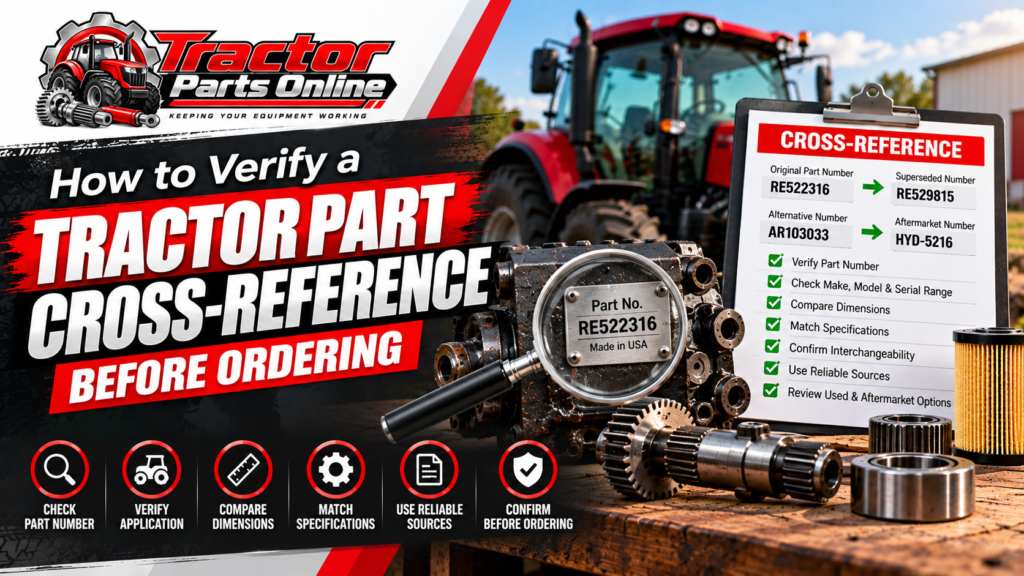
Finding a replacement component is easier when you can confirm it is actually compatible with your tractor. A tractor part cross-reference can connect an original part number with a superseded, equivalent, or alternative number, but a matching number alone does not always prove fitment. Serial ranges, production changes, dimensions, and technical specifications can matter. Before ordering tractor replacement parts, verify the original number, application, physical details, and operating requirements. This process helps reduce the risk of receiving a part that looks correct but cannot be installed or used properly.
What Is a Tractor Part Cross-Reference?
A tractor part cross-reference compares one part number with another to determine whether they refer to the same component or an acceptable replacement. Information may come from manufacturer catalogs, parts diagrams, supplier databases, or interchange references.
A tractor part number cross-reference may identify a newer replacement number when an older OEM number has been superseded. It can also identify a compatible aftermarket part. However, cross-reference information should be treated as a starting point for verification, not automatic proof of compatibility.
Step 1: Record the Original Part Number
Start with the number printed, stamped, or cast on the existing component. Record every visible character, including prefixes, suffixes, and revision letters.
Also note the tractor make, model, and serial number. Similar tractors can use different components because of production changes, engine options, transmission types, or attachments. Accurate tractor part identification gives you a stronger basis for every later check.
If the original number is unreadable, use a tractor parts catalog, diagram, or tractor part lookup tool to identify the component before comparing alternatives.
Step 2: Check Manufacturer Parts Information
Determine whether the original number is current, superseded, or obsolete. An OEM tractor part number may have been replaced by a newer number that serves the same application.
Look for:
- Original and superseding numbers
- Applicable tractor models
- Serial-number ranges
- Related assemblies
- Notes about updated designs
A tractor parts database or official parts catalog can help. Do not assume two numbers are interchangeable simply because they appear together in a search result.
Step 3: Confirm the Application and Serial Range
Matching the tractor model while ignoring the serial range is a common cross-reference mistake. Manufacturers can change components during a model’s production cycle.
Check whether the referenced part applies to your exact tractor configuration. This matters especially for engines, transmissions, hydraulic assemblies, steering components, electrical parts, and PTO systems.
When information conflicts, verify it with a parts diagram or supplier instead of relying on appearance.
Step 4: Compare Physical Dimensions
A cross-reference should be supported by physical comparison. Check mounting-hole positions, shaft diameter, overall dimensions, thread type, gear count, connector style, and other relevant measurements.
For example, two hydraulic components may have similar housings but different ports or operating specifications. A transmission gear may look similar but have a different tooth count. Physical measurements can reveal differences that a basic tractor parts lookup misses.
Step 5: Compare Technical Specifications
Physical fit is only one part of tractor part compatibility. Some components must also meet specific operating requirements.
Depending on the part, verify:
- Pressure and flow ratings
- Voltage or amperage
- Capacity
- Rotation direction
- Gear ratio
- Shaft or spline configuration
- Connection or port specifications
This is important when comparing OEM tractor parts with tractor aftermarket parts. An aftermarket component may be suitable when its specifications and application match, but the comparison should be based on documented information.
Step 6: Understand What “Interchangeable” Means
Interchangeable tractor parts can serve the same application, but the phrase does not always mean they are identical. A part may be a direct replacement, a manufacturer-superseded design, or a compatible alternative that requires different installation steps.
Ask whether the cross-reference means “same part,” “superseded part,” or “compatible alternative.” These descriptions can have different implications for installation and performance.
Step 7: Verify the Cross-Reference Source
Not every online cross-reference has the same reliability. A supplier may base its data on manufacturer information, catalog research, or inventory records, while marketplace listings may contain incomplete numbers.
Compare important references across dependable sources when possible. For brand-specific sourcing, review relevant John Deere parts information and confirm that the application matches your original component.
The same process applies when checking New Holland parts. The goal is to confirm fitment, not simply find a similar-looking listing.
Step 8: Evaluate Used and Aftermarket Alternatives
A cross-reference can identify an alternative without telling you its condition or manufacturing source. Used tractor parts and aftermarket components should be evaluated separately from OEM replacements.
For used components, check wear, corrosion, previous repairs, and identification markings. For aftermarket parts, verify dimensions, specifications, application coverage, and installation requirements.
Do not assume that a lower-cost alternative is automatically equivalent. The correct choice depends on the component and the tractor’s requirements.
Step 9: Confirm Everything Before Ordering
Before placing the order, compare:
- Original part number
- Replacement or cross-reference number
- Tractor make and model
- Serial-number range
- Physical dimensions
- Technical specifications
- Application notes
- Part condition and source
If one detail remains uncertain, ask the supplier for written confirmation. Providing the exact tractor information and original part number makes the question easier to resolve.
Common Tractor Parts Cross-Reference Mistakes
Searching only by model name, relying on photographs, ignoring serial ranges, or assuming an aftermarket number is automatically equivalent can lead to incorrect orders.
Another mistake is confusing a related component with the actual replacement. A listing may describe a complete assembly while you need only one internal component. Check diagrams, descriptions, and included parts carefully.
Conclusion
A tractor part cross-reference is most useful when it becomes part of a complete verification process. Start with the original number, confirm the application and serial range, compare dimensions and specifications, and determine whether the reference indicates an exact replacement, superseded number, or alternative component. These checks can make tractor parts lookup more reliable and reduce avoidable compatibility problems. When information is unclear, verify the application with a dependable parts catalog or supplier before ordering.
FAQ's
Accuracy depends on the source and the quality of the underlying parts information. A cross-reference is more useful when supported by manufacturer data, application details, and serial-range information.
Sometimes. The replacement should match the application's physical and technical requirements. Verify fitment and specifications before ordering.
Compare manufacturer information, application, serial range, dimensions, specifications, and replacement notes. Do not rely on the numbers alone.
The most useful details are the tractor make, model, serial number, original part number, and a clear description or photo of the component.