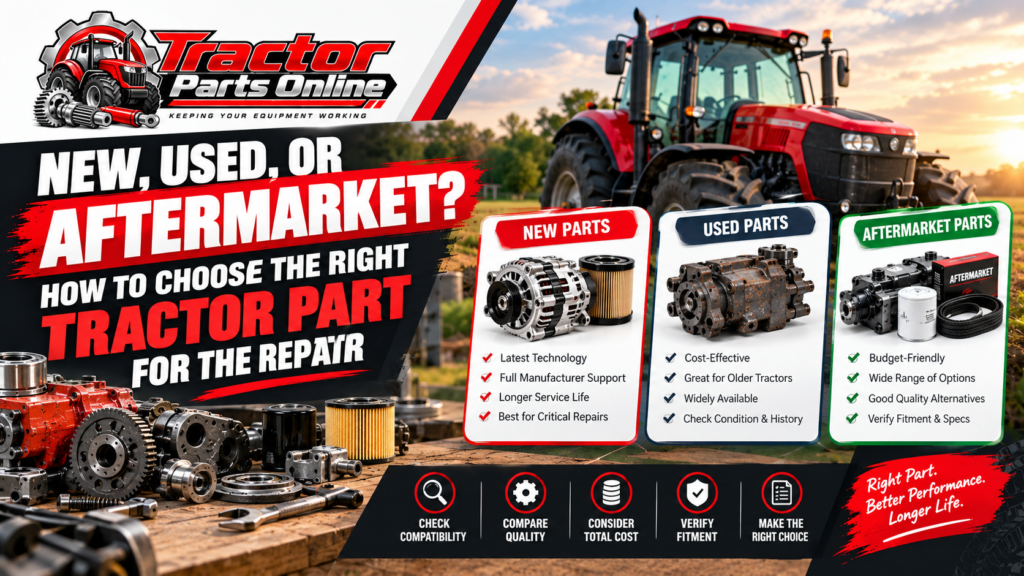
Choosing tractor replacement parts is not simply a matter of finding the cheapest listing or matching a part by appearance. New, used, and aftermarket components can all be appropriate depending on the repair, the tractor’s age, the part’s function, and availability. The right choice starts with confirming compatibility and then comparing condition, quality, and total cost. This guide explains when new tractor parts make sense, when used components are practical, and when aftermarket replacement tractor parts can be a reasonable alternative.
Start With the Repair, Not the Price
Before comparing suppliers, identify exactly what the repair requires. A high-wear component or critical assembly may need a different sourcing approach than a bracket, cover, or body panel.
Check the tractor make, model, serial number, original part number, and relevant specifications. This information helps a tractor parts dealer confirm fitment and reduces the chance of ordering a component that looks similar but will not work correctly.
It also helps you decide whether the priority is service life, immediate availability, lower acquisition cost, or access to a part that is no longer produced.
When New Tractor Parts Make Sense
New tractor parts are often the straightforward option when the component is readily available and its condition directly affects reliability. A new part can also make sense when labor is expensive or access to the component requires substantial disassembly.
Consider new parts for:
- Critical engine or fuel-system components
- Important hydraulic or transmission components
- Seals, bearings, filters, and other wear items
- Components where previous operating history matters
OEM tractor parts can be useful when exact specifications or fitment are important. New genuine tractor parts may also be preferable when you want the original specification rather than an alternative design.
The limitation is availability. Older tractors may require a superseded number, used part, or aftermarket replacement.
When Used Tractor Parts Are Practical
Used tractor parts can be sensible when the component is durable, difficult to source new, or available from a dismantled machine in usable condition. They are especially relevant for older tractors.
Examples include:
- Housings and brackets
- Axle and steering components
- Sheet-metal and body panels
- Gear housings
- Certain transmission or hydraulic assemblies
The key question is not simply whether a part is used, but whether its remaining condition suits the repair. Ask about visible wear, corrosion, cracks, previous repairs, testing, and included hardware.
For hard-to-find components, a used tractor parts supplier may provide inventory that no longer appears in current catalogs. Verify the original part number and tractor application before ordering.
When Aftermarket Tractor Parts Can Work
Aftermarket tractor parts are produced by companies other than the original equipment manufacturer. They can be useful when an OEM component is unavailable, when compatible options exist, or when you need a replacement outside current manufacturer inventory.
Do not judge an aftermarket part only by price. Verify:
- Correct part number or cross-reference
- Tractor model and serial compatibility
- Dimensions and mounting points
- Material or construction where relevant
- Pressure, voltage, capacity, or other operating specifications
- Supplier fitment information
- Return or warranty terms
A lower-priced component may be suitable, while another may not meet the application’s requirements. Fitment and documented specifications should guide the decision.
Compare Tractor Part Quality and Fitment
Whatever source you choose, tractor part quality and tractor part fitment should be checked before purchase. A part that physically fits may still have the wrong operating characteristics, and a high-quality component is not useful if it cannot be installed correctly.
Compare the replacement against the original using measurements, photographs, diagrams, and supplier information. For mechanical components, pay attention to shafts, splines, threads, bearings, gear counts, mounting holes, and connection points.
For hydraulic, electrical, and transmission parts, technical specifications are especially important. If a listing provides only a model name and photograph, ask for more details before ordering.
Consider Availability and Total Repair Cost
The lowest purchase price is not always the lowest repair cost. A used component may cost less initially but require cleaning, rebuilding, or additional seals. A new OEM part may cost more but reduce uncertainty. An aftermarket component may balance availability and cost when its specifications are properly verified.
Consider:
- Purchase price
- Shipping
- Installation work
- Additional refurbishment
- Return costs if the part is incorrect
This approach is useful when comparing affordable tractor parts with a more expensive option.
Where to Source Replacement Tractor Parts
The best source depends on the repair and the part’s availability. Manufacturer channels can help identify OEM numbers and current replacements. A tractor parts supplier or dealer may have new, used, or aftermarket inventory and may be able to verify application information.
For brand-specific sourcing, you can review John Deere parts when researching compatible components. For New Holland equipment, New Holland parts can be another starting point for model-specific options.
Online tractor parts marketplaces can expand the search, especially for discontinued or used components. Compare listings carefully because descriptions and condition standards can differ.
A Simple Decision Framework
Use these questions before ordering:
Is the part safety-critical or highly technical?
Prioritize verified fitment, specifications, and known condition.
Is the part widely available new?
Compare new OEM and aftermarket options.
Is the tractor older or the component discontinued?
Consider used, refurbished, or superseded parts.
Does the component have predictable wear?
Check condition carefully before choosing used parts.
Will installation be difficult or expensive?
Reducing the risk of premature failure may justify a higher-quality replacement.
There is no single category that fits every repair. The appropriate choice depends on the part and the tractor’s requirements.
Conclusion
Choosing between new, used, and aftermarket tractor replacement parts starts with the repair itself. New OEM components can provide a direct sourcing path when available, while used parts can help with older or discontinued equipment. Aftermarket options can broaden availability when the replacement is properly matched to the application. Before ordering, verify part numbers, fitment, condition, specifications, and total repair cost. A careful comparison gives you a stronger basis for selecting tractor repair parts that suit the machine rather than simply choosing the lowest-priced listing.
FAQ's
Not necessarily. OEM parts follow the manufacturer's specifications, while aftermarket parts vary by manufacturer and application. Compare fitment, quality information, specifications, and warranty terms.
Used components can make sense when the part is durable, difficult to source new, or no longer manufactured. Verify condition, identification, compatibility, and testing before purchase.
Price alone does not determine suitability. A low-cost part can work when its fitment and specifications are correct, but an incorrect component can create additional labor and repair costs.
Use the tractor's make, model, serial number, original part number, dimensions, and technical specifications. Ask the supplier to confirm the application when any detail is uncertain.