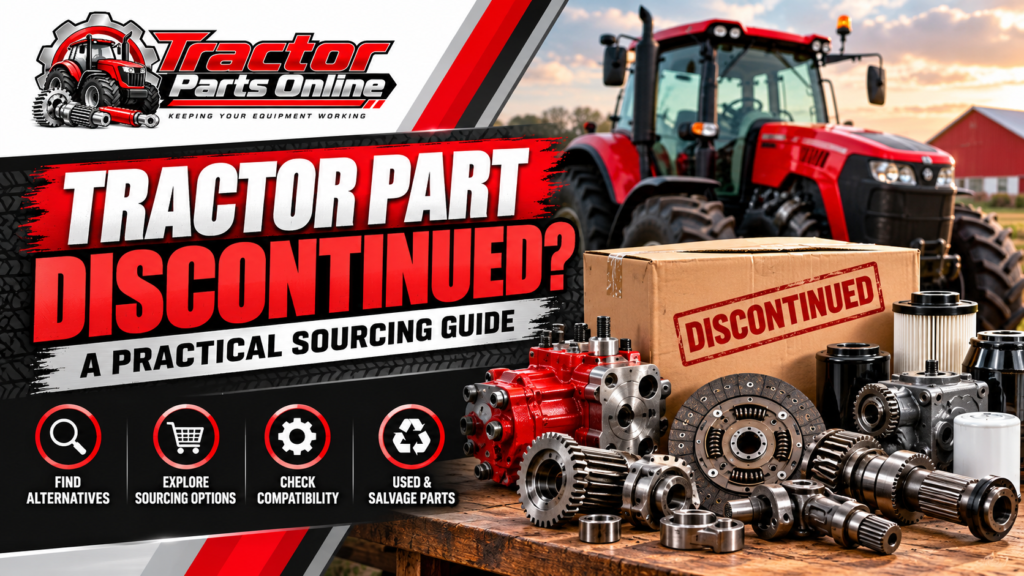
Discontinued tractor parts can turn a routine repair into a sourcing problem. When an OEM manufacturer stops producing a component, the original part may disappear from normal dealer inventories, but that does not always mean the repair is impossible. You may still have several practical options, including compatible replacements, aftermarket components, used parts, salvage inventory, or professionally rebuilt units. The key is to identify the exact part, understand what must match, and compare replacement options before buying. This guide explains how to find discontinued tractor parts, where to look, and how to reduce the risk of ordering a part that does not fit or perform as expected.
Why Tractor Parts Become Discontinued
Manufacturers discontinue parts for many reasons. A tractor model may be replaced by a newer generation, production volumes may become too low, or a component may be superseded by a redesigned version. In other cases, the original supplier may stop making a specific component.
When this happens, the part number you have may show as unavailable even though an equivalent component exists under a newer number. That is why “tractor parts no longer available” does not always mean there is no solution. The first step is determining whether the original part was truly discontinued or simply replaced.
How to Find Discontinued Tractor Parts
Start with the tractor’s exact information: make, model, year when available, serial number, and the original part number. These details can prevent costly mistakes, especially when manufacturers changed components during a model’s production run.
Next, search the original part number rather than relying only on a general description such as “hydraulic pump” or “PTO shaft.” A part number can reveal dealer stock, replacement numbers, used inventory, salvage listings, and cross-reference information.
Useful sources include:
- Authorized dealers and manufacturer parts departments for superseded or replacement numbers
- Specialty tractor parts suppliers with older inventory
- Used tractor parts online marketplaces and equipment dismantlers
- Tractor salvage yards with machines available for dismantling
- Aftermarket manufacturers that produce compatible components
For older machines, searching by the original part number plus the tractor model can be more productive than searching by the part name alone.
Where to Buy Discontinued Tractor Parts
There is no single source for hard to find tractor parts. The right option depends on the part, condition requirements, and availability.
New old stock, often called NOS, can be useful when you need the original design and a previously manufactured component is still sitting in inventory. Used tractor parts are another option for components that remain difficult to source new. Salvage businesses may have parts removed from tractors that are no longer economically repairable.
You can also search suppliers offering tractor parts when looking for broader sourcing options. For specialized components, it helps to search by system as well as by model, such as hydraulic, transmission, electrical, engine, or PTO parts.
Check for Replacement and Compatible Parts
One of the most important steps in a discontinued tractor parts search is finding out whether the original component has a replacement.
A manufacturer may issue a superseding part number that replaces the older design. The replacement may look different but still be approved for the same application. This is common enough that buyers should never assume an old number is the only acceptable reference.
Aftermarket tractor parts can also solve the problem, but compatibility needs to be verified carefully. Compare dimensions, mounting points, shaft sizes, connections, pressure or capacity ratings, materials, and operating requirements where applicable.
Do not rely on a statement that a part is “for your model” without checking the specific application. Model compatibility can vary by serial number or production year.
Consider Used and Salvage Parts
Used tractor parts are often practical when a new replacement cannot be found or when the original design is no longer manufactured. Components such as housings, gear assemblies, brackets, panels, axles, and other durable items may remain usable after being removed from another machine.
When buying used parts, ask for the exact part number, machine model, serial-number range when relevant, and clear photos of identification marks. Inspect wear points, cracks, corrosion, splines, threads, seals, and other areas that affect function.
Salvage inventory can be especially helpful for rare tractor parts. A salvage yard may have a complete donor machine even when the exact component is no longer listed in normal catalogs. However, condition and return policies matter, so verify what you are purchasing before payment.
Know When a Hydraulic or Other Specialized Part Needs Extra Care
Some discontinued components require more than a visual match. Hydraulic pumps, valves, cylinders, motors, and related assemblies may depend on pressure ratings, flow specifications, port sizes, control arrangements, and mounting dimensions.
When sourcing these components, match the technical specifications, not just the tractor name. A useful starting point is to review suppliers specializing in tractor hydraulic parts and then confirm the exact application.
The same principle applies to transmission, PTO, electrical, and fuel-system components. A part that physically fits may still be unsuitable if its specifications differ from the original requirement.
How to Avoid Buying the Wrong Part
Before placing an order, create a simple verification checklist:
- Confirm the tractor make, model, and serial number.
- Record the original part number and any superseding number.
- Compare dimensions and connection points.
- Check technical specifications and operating requirements.
- Confirm whether the part is new, used, rebuilt, or aftermarket.
- Ask about compatibility and return conditions.
- Keep photos of the original component for reference.
This process is particularly useful when sourcing old tractor parts or rare components from online sellers. Clear identification is more reliable than appearance alone.
Conclusion
Finding discontinued tractor parts is usually a matter of identifying the component accurately and expanding the search beyond current OEM inventory. Check for superseded part numbers first, then consider new old stock, compatible aftermarket parts, used components, and tractor salvage parts. For specialized systems, verify technical specifications as carefully as the fit. A structured sourcing process can make even rare or obsolete tractor parts easier to locate while reducing the chance of an expensive mismatch.
FAQ's
Yes. Discontinued does not necessarily mean unavailable. The part may exist as old inventory, a superseded part number, a used component, a salvage part, or an aftermarket alternative.
Far far away, behind the word mountains, far from the countries Vokalia and Consonantia, there live the blind texts. Separated they live in Bookmarksgrove right at the coast
They can be suitable when the part is correctly specified for the application. Verify dimensions, materials, ratings, connections, and other technical requirements before purchase.
Look at specialty tractor parts suppliers, equipment dismantlers, used-part marketplaces, and dealers with older inventory. Searching by part number usually gives more precise results than a general keyword search.