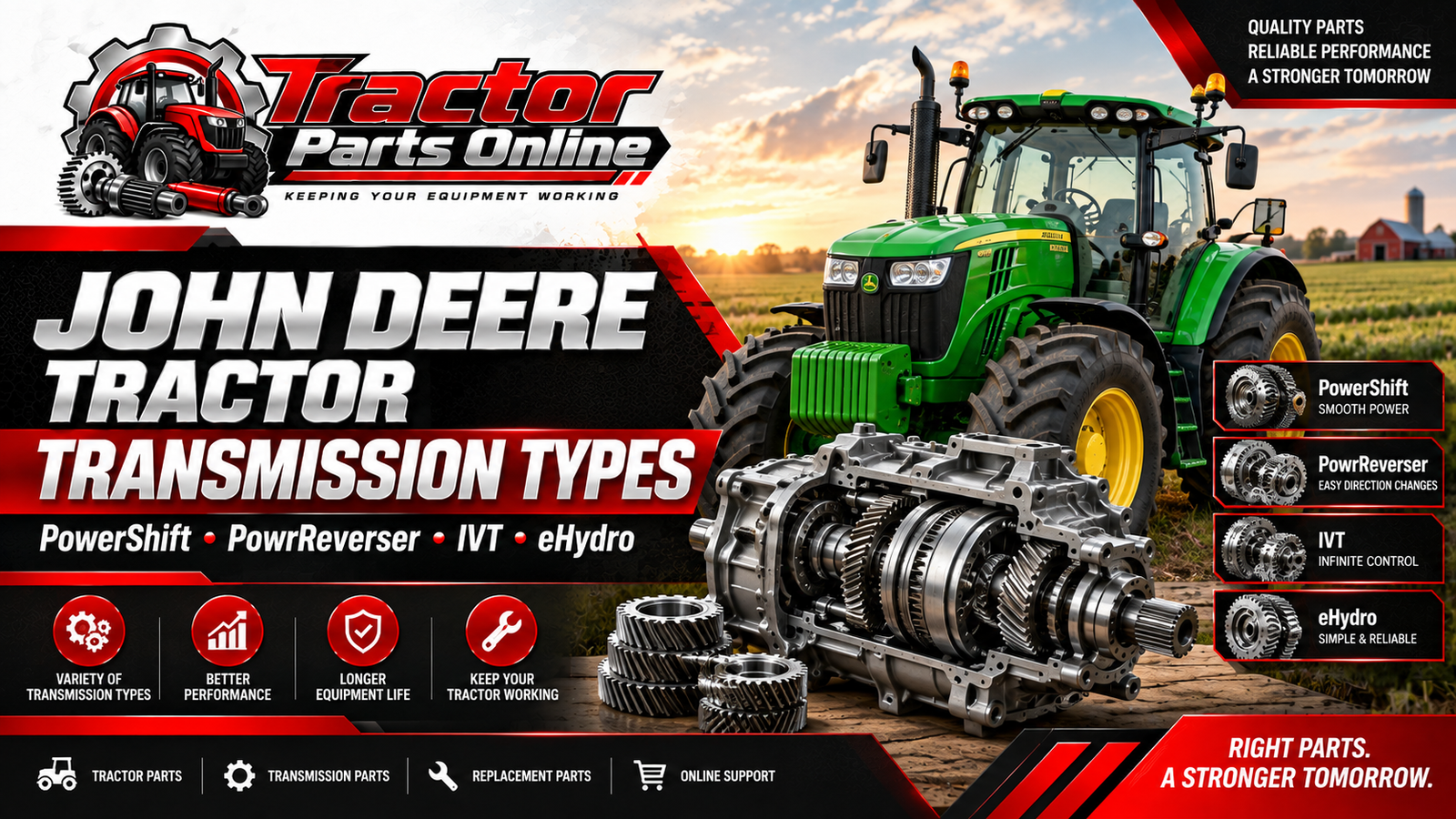
John Deere tractors are offered with different transmission systems because operating needs vary by tractor class, model, and application. The main John Deere tractor transmission types include mechanical and synchronized transmissions, PowrReverser, PowerShift, continuously variable transmissions such as IVT, and hydrostatic systems on some compact and utility tractors. Newer models can also use named variants such as e19 PowerShift or e18, depending on the tractor series and generation. The transmission affects how the tractor changes speed, direction, and power delivery, so understanding the differences is useful when buying, operating, or repairing a machine.
What are the main John Deere tractor transmission types?
There is no single John Deere transmission used across the entire tractor range. Availability depends on the specific model, series, generation, and market. For example, John Deere lists PowrQuad Plus, AutoQuad Plus, e19 PowerShift, and AutoPowr/IVT options on certain 6M tractors, while 8 Series tractors offer PowerShift and AutoPowr/IVT options.
A transmission name alone is therefore not enough when identifying a tractor. Check the model number, serial information, operator’s manual, or build specifications before ordering John Deere transmission parts.
Mechanical and synchronized transmissions
Traditional mechanical transmissions use gears and a clutch to transfer engine power to the driveline. Depending on the design, the operator selects individual gears and ranges manually.
A synchronized transmission uses synchronizers to make gear changes smoother by matching rotating components before engagement. These systems can be found on older tractor designs, but the controls, lubrication requirements, and service procedures vary by model.
Do not assume an older John Deere tractor gearbox matches a newer machine. Parts and adjustment procedures can differ considerably between generations.
John Deere PowrReverser transmission
The PowrReverser is designed to make forward and reverse changes easier while retaining multiple gear and range combinations. John Deere documentation for certain compact tractors describes a 12-forward, 12-reverse PowrReverser transmission, while the same models were also available with eHydro.
PowrReverser can suit applications involving frequent directional changes, such as loader work. Because configurations vary, operators should follow the procedure specified for their tractor.
John Deere PowerShift transmission
A John Deere PowerShift transmission allows gear changes under load without the same manual clutch operation associated with a conventional mechanical gearbox. John Deere describes the e23 PowerShift on some 8 Series tractors as a 23-forward-speed transmission, while other models use different PowerShift configurations.
Older PowerShift designs also exist, so the term covers more than one transmission generation. Gear counts, controls, and service procedures depend on the specific tractor.
PowerShift systems can be useful where maintaining speed and power while changing gears matters, but operators should still select suitable ranges for the implement and conditions.
John Deere IVT and AutoPowr transmissions
IVT stands for infinitely variable transmission. John Deere commonly uses the AutoPowr/IVT name for its continuously variable transmission system.
Rather than relying only on fixed gears, an IVT continuously varies the transmission ratio within its operating range. This provides precise speed control for work where maintaining a particular travel speed is important.
John Deere lists AutoPowr/IVT options on several tractor models. Available speed ranges and controls vary, so check the specifications for the exact tractor.
John Deere hydrostatic transmission
Hydrostatic transmissions are commonly associated with smaller John Deere tractors and equipment. Instead of using a conventional gear-selection process alone, hydrostatic systems use hydraulic power to control travel speed and direction.
John Deere documentation for certain 3 Series compact utility tractors shows eHydro transmissions with infinite forward and reverse speed control within the available ranges.
Hydrostatic systems can be convenient for tasks requiring frequent speed adjustments or direction changes. They also have different troubleshooting and maintenance considerations from mechanical and PowerShift designs.
What is the John Deere e18 transmission?
The e18 is a specific John Deere transmission configuration rather than a broad category such as mechanical or IVT. John Deere specifications have listed e18 as an 18-forward, 6-reverse-speed transmission with Efficiency Manager on certain large 9 Series tractors.
Because e18 belongs to particular tractor configurations, confirm the exact model before searching for replacement components. A tractor described only as having a PowerShift transmission may still require model and serial information before the correct parts can be selected.
How do you choose between John Deere transmission options?
Consider how the tractor will be used.
Look at:
- Type of work and implements
- Frequency of direction changes
- Required travel-speed control
- Field or road operating conditions
- Tractor horsepower and series
- Service history and parts availability
A tractor used for loader work may benefit from controls suited to repeated forward and reverse changes. A field tractor may place more emphasis on maintaining a consistent working speed.
When buying used equipment, verify the actual factory configuration rather than relying only on a sales description.
John Deere transmission maintenance and troubleshooting
Maintenance requirements differ by transmission design, so use service information for the exact tractor. Fluid type, fluid level, filters, adjustment, and inspection intervals are not interchangeable between models.
Warning signs such as abnormal noise, delayed engagement, slipping, difficult gear changes, unexpected movement, or fluid leakage deserve investigation. These symptoms can have different causes, so replacing a major transmission component without diagnosis may be unnecessary.
Before ordering John Deere transmission replacement parts, record the tractor model, serial number, transmission type, and existing component or part number where available.
Buying John Deere transmission parts
When a transmission requires repair, the correct replacement component matters as much as the transmission type. Tractor Parts Online provides a dedicated John Deere tractor parts section where transmission components and other tractor parts can be reviewed.
You can also use the Tractor Parts Online homepage to search available parts and product categories. Before purchasing, compare the part number, compatibility information, dimensions, and condition. Used, remanufactured, and aftermarket components may have different specifications and warranty terms.
For general background on the brand and its agricultural equipment, see John Deere on Wikipedia.
Conclusion
John Deere tractor transmission types range from traditional mechanical systems to PowrReverser, PowerShift, IVT/AutoPowr, and hydrostatic designs. The available transmission depends on the tractor model, series, generation, and configuration. Understanding these differences helps owners select the correct operating approach and identify suitable transmission components when repairs are needed. For maintenance or replacement work, always match the transmission and part to the exact tractor specifications rather than relying on a general transmission name.
FAQ's
John Deere tractors use different systems depending on the model and generation, including mechanical, PowrReverser, PowerShift, IVT/AutoPowr, and hydrostatic transmissions.
No. A PowerShift uses a defined set of gears that can be shifted under load, while an IVT continuously varies the transmission ratio within its operating range.
PowrReverser is a John Deere transmission design that provides multiple forward and reverse speeds with a reverser control for changing direction. Exact gear counts and features vary by tractor.
Start with the tractor model and serial number, then check the operator's manual or technical specifications. This is more reliable than identifying the system only by appearance.