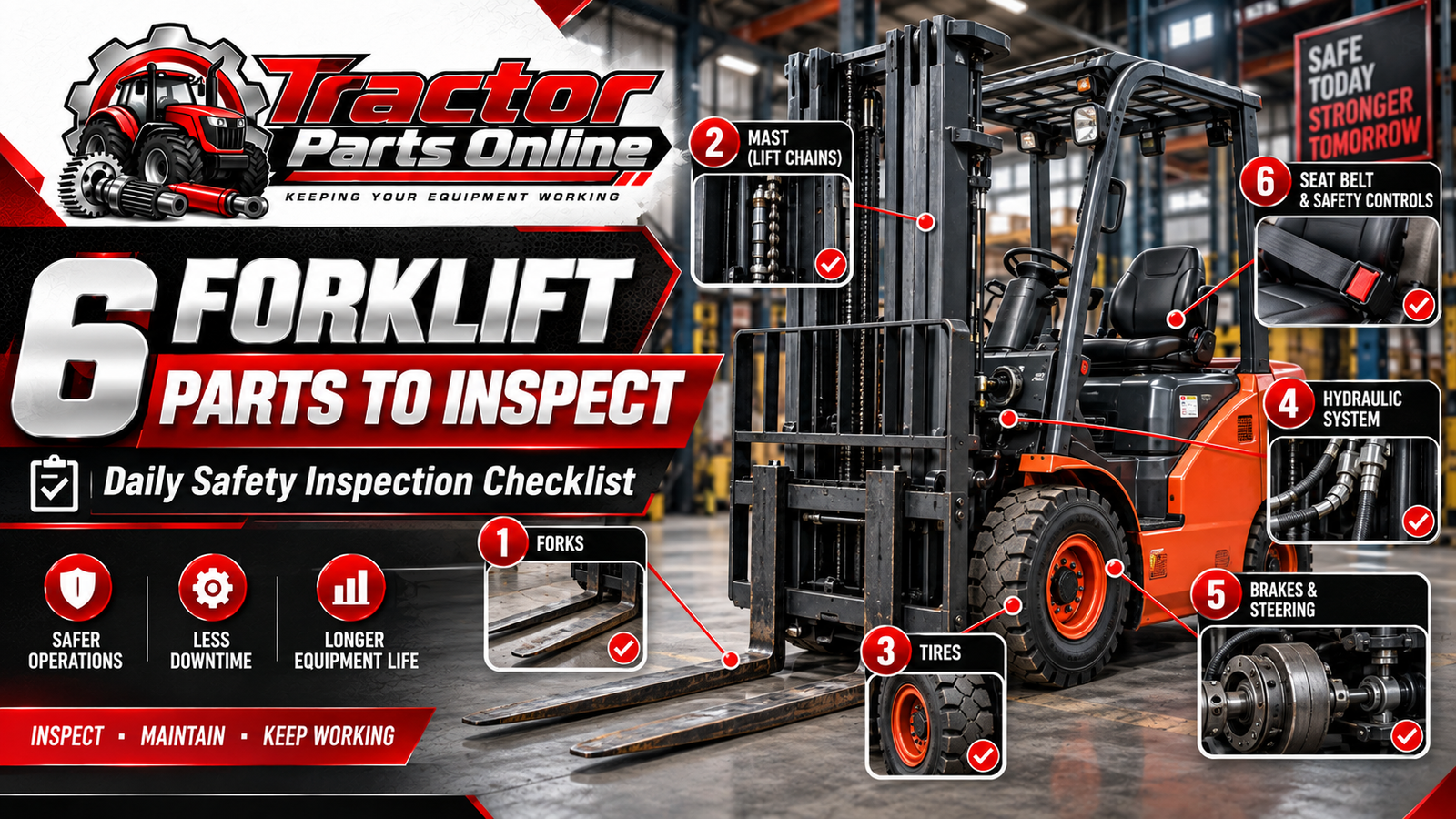
A forklift should be inspected before it is placed into service, but there is no universal OSHA rule that limits the inspection to exactly six parts. OSHA’s guidance covers a broader range of mechanical, fluid, and safety items. For a practical forklift parts inspection, six key groups deserve close attention: forks, mast and lift chains, tires, hydraulic systems, brakes and steering, and the seat belt and safety controls. These checks help identify visible defects and operating problems before the forklift is used.
The Six Key Forklift Inspection Points
1. Forks
Forks carry the load and need careful visual inspection. Look for cracks, bends, excessive wear, heel damage, and problems with the retaining pin or top clip.
Check that the forks are suitable for the truck and intended load. Mismatched or damaged forks can affect load handling and stability. Also check for excessive oil or water on the fork surfaces.
A forklift load capacity inspection should include the capacity plate or nameplate. It should be present, legible, and matched to the truck, model, serial information, and attachments. Never assume a forklift can safely carry a load simply because the forks fit beneath it.
2. Mast, Lift Chains, and Rollers
The mast assembly supports lifting and lowering. During a forklift mast inspection, look for cracks, bent sections, damaged welds, loose components, or missing stops.
Inspect lift chains and rollers for wear, kinks, corrosion, damage, or signs that lubrication is needed. Do not place hands inside the mast while checking chain condition; use the manufacturer’s recommended inspection method.
Unusual movement, noise, or visible mast damage should be investigated before the truck is returned to service.
3. Tires and Wheels
A forklift tires inspection should look beyond basic appearance. Check for deep cuts, gouges, missing rubber, separation, damaged tread, or other deterioration. Where applicable, check pneumatic tire pressure according to the manufacturer’s specifications.
Also look for visibly loose or damaged wheel hardware. Tire condition affects steering, braking, and stability.
4. Hydraulic System
The hydraulic system powers lifting, lowering, tilting, and attachments on many forklifts. A forklift hydraulic system inspection should include hoses, cylinders, fittings, and hydraulic fluid level.
Look for leaks, damaged hoses, loose connections, and oil around cylinders. During the operational check, make sure the forks and attachments move smoothly without abnormal hesitation.
Hydraulic leaks should not be ignored. A leak can reduce equipment performance and create additional hazards. Repairs should be performed by authorized or properly qualified personnel.
5. Brakes and Steering
A forklift safety inspection should include the systems that control movement. During a forklift brakes inspection, check that the service brake and parking brake work properly and that the truck stops predictably.
The forklift steering inspection should confirm smooth movement without excessive free play. Also test forward and reverse controls during the operational check.
Unexpected vibration, unusual noise, delayed response, or difficult steering should be reported rather than treated as normal.
6. Seat Belt and Safety Controls
The sixth group covers operator protection and safety equipment. A forklift seat belt inspection should confirm that the restraint is present, fastens correctly, and functions properly.
Inspect the horn, lights, warning devices, safety decals, and other equipment fitted to the truck. The exact equipment varies by forklift type, so the manufacturer’s instructions should be included in the forklift inspection checklist.
A damaged warning label, missing capacity information, or faulty safety device can also require attention because these items support safe operation.
How Should a Forklift Daily Inspection Be Performed?
A forklift pre operation inspection generally has two stages: a visual check with the truck turned off, followed by an operational check after starting it. OSHA says powered industrial trucks must be examined before being placed in service at least daily, or after each shift when used around the clock. A truck should not be placed in service when the examination identifies a condition that adversely affects safety.
A practical daily forklift checklist can include:
- Inspect forks, mast, lift chains, rollers, and load backrest.
- Check tires, visible leaks, cracks, and other damage.
- Check hydraulic and other required fluid levels.
- Inspect the seat belt, capacity plate, warning decals, and safety equipment.
- Start the truck and test brakes, steering, drive controls, horn, lights, and attachments.
- Record defects and report unsafe conditions before operation.
OSHA’s sample checklist is a guide rather than a complete universal list. It recommends adapting inspection procedures to the specific truck and consulting the manufacturer’s instructions.
What Should Happen If a Forklift Fails Inspection?
A forklift that is defective or otherwise unsafe should be removed from service until the problem is corrected. OSHA requires defects found during the examination to be reported and corrected, and its standard requires repairs to be made by authorized personnel.
When replacement components are needed, identify the forklift model, serial number, component, and part information before ordering. Tractor Parts Online provides parts resources for material-handling equipment through its forklift and tractor parts website. For help identifying a replacement component, use the site’s contact page to provide equipment and part details.
Why Regular Forklift Inspections Matter
A forklift daily inspection is more than a checklist exercise. It gives operators a consistent opportunity to identify worn components, leaks, damage, and control problems before the truck enters the work area.
Inspection findings can support maintenance planning. Repeated tire damage, hydraulic leaks, or brake issues may indicate components that need repair or replacement.
For general background on the equipment, see the Forklift article on Wikipedia.
Conclusion
The six key areas in a forklift parts inspection are the forks, mast and lift chains, tires, hydraulic system, brakes and steering, and seat belt and safety controls. These should form part of a broader forklift safety inspection that also considers fluids, attachments, warning devices, capacity information, and model-specific requirements. Daily inspection is most useful when operators follow a consistent process and unsafe conditions are reported and corrected promptly. A forklift with a safety-related defect should remain out of service until the issue has been addressed.
FAQ's
A practical six-group inspection covers forks, mast and lift chains, tires, hydraulics, brakes and steering, and the seat belt and safety controls. The complete inspection should also follow the forklift manufacturer's requirements.
The operator generally performs the pre-operation examination as part of workplace procedures and required training. Employers are responsible for establishing appropriate inspection, maintenance, and corrective-action processes.
Do not use the forklift until the condition has been properly evaluated and corrected. Cracked, bent, mismatched, or excessively worn forks can affect safe load handling.
OSHA requires the forklift to be examined before being placed in service, but it does not specifically require a written checklist for every inspection. Employers still need an effective inspection process, and a documented checklist can help standardize workplace procedures.