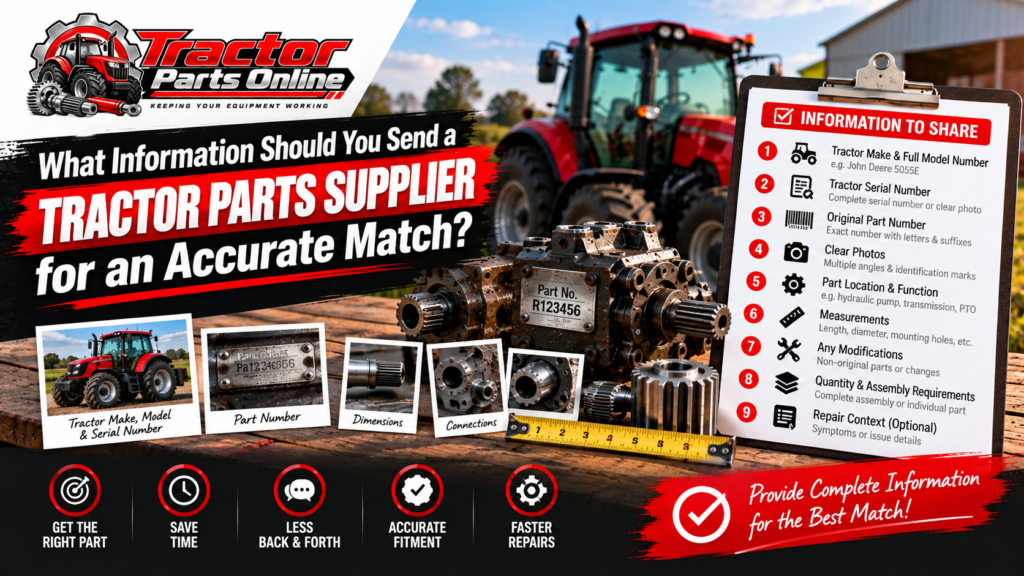
The fastest way to get the right tractor replacement parts is to give a supplier enough information to identify the exact application. A tractor model name alone may not be sufficient because manufacturers can change components within the same model series. Providing the model number, serial number, original part number, photos, measurements, and component details gives a supplier a stronger basis for tractor part matching.
Start With the Tractor Make and Model
Begin with the manufacturer’s name and exact model designation. Write the complete model number rather than a shortened version.
Do not send only a brand name and say you need a hydraulic component. Include the full model and, when available, the series or configuration. This helps narrow the relevant parts catalog.
The model identifies the general application, but it is not always enough because production changes can result in different components within the same model.
Provide the Tractor Serial Number
The tractor serial number is one of the most useful details for accurate parts identification. It can help determine where a machine falls within its production range and whether a component changed during manufacturing.
Send the complete serial number exactly as it appears. If you are unsure which number is the serial number, provide a clear photo of the identification plate.
For older equipment, this detail is particularly useful because parts may have been revised, superseded, or discontinued.
Include the Original Tractor Part Number
If the existing component has a stamped, printed, cast, or engraved part number, send it exactly as shown. Include letters, numbers, prefixes, and suffixes.
A tractor OEM part number gives the supplier a direct starting point for a tractor parts lookup. It may also allow the supplier to check whether a replacement tractor part number has superseded the original.
Do not remove a character simply because it looks unimportant. Small differences can identify different revisions or applications.
Send Clear Photos From Multiple Angles
Photos can help confirm what written information does not show. Take well-lit images of the complete component and close-ups of identification markings.
Useful photos should show:
- The full part
- Part number or casting marks
- Mounting points
- Shafts, splines, gears, or threads
- Hydraulic or electrical connections
- Visible damage or modifications
For tractor parts online, clear images are especially useful when the original number is worn or unreadable.
Describe the Part’s Location and Function
Tell the supplier where the component is installed and what it does. Saying “I need a pump” is less useful than explaining that it is a hydraulic pump serving a particular tractor hydraulic circuit.
Mention whether it belongs to the engine, transmission, hydraulic system, PTO, steering, electrical system, fuel system, or another assembly.
If possible, describe the problem as well. Symptoms can provide context, although they should not be used alone to determine the exact replacement.
Provide Measurements When Necessary
Measurements can resolve uncertainty between visually similar parts. Depending on the component, useful measurements include overall length, shaft diameter, mounting-hole spacing, thread size, port size, gear count, or connector type.
Use consistent units and measure the original component carefully. For technical parts, dimensional differences can affect tractor parts fitment.
Measurements should supplement the model, serial number, and part number. They are most useful when several compatible tractor parts appear similar.
Mention Any Existing Modifications
Older tractors may have been repaired or modified during their working life. The component currently installed may not match the factory configuration.
Tell the supplier if the tractor has a replacement engine, modified hydraulic plumbing, non-original brackets, converted electrical components, or other known changes.
This can prevent a supplier from recommending a factory-original part that does not match the machine’s current setup.
Explain Quantity and Assembly Requirements
State how many parts you need and whether you require a complete assembly or only an individual component.
A hydraulic repair, for example, may require a complete pump assembly, while another repair may need a seal, coupling, valve, or mounting component. A supplier can match the request more accurately when the required assembly level is clear.
Also mention whether related hardware must be included, such as gaskets, fittings, brackets, sensors, or mounting bolts.
Use This Information as a Supplier Checklist
For an efficient request, send:
- Tractor make and full model number
- Complete serial number
- Original tractor part number
- Clear photos from several angles
- Part location and function
- Important dimensions or specifications
- Known modifications
- Quantity and assembly requirements
- Symptoms or repair context, when relevant
You can also state whether you prefer OEM tractor parts, aftermarket alternatives, used components, or any compatible replacement that meets the required specifications.
Brand-Specific Information Can Improve Fitment
For brand-specific sourcing, make the request precise. For example, when looking for Kubota parts, include the exact model and serial information rather than simply asking for a Kubota component.
The same principle applies when sourcing Massey Ferguson parts. Detailed machine information helps narrow the catalog and check available replacement numbers.
Why Complete Information Saves Time
Incomplete requests often lead to additional messages, uncertain matches, or incorrect assumptions. Sending the key information together gives the supplier enough context to check catalogs, compatibility references, dimensions, and replacement numbers.
This matters especially for older machines and hard-to-find components. Accurate application details make it easier to distinguish between a genuine replacement, a superseded part, and a component that only looks similar.
Conclusion
A tractor parts supplier can make a more accurate match when you provide complete machine and component information. Start with the make, model, serial number, and original part number, then add clear photos, measurements, application details, and information about modifications. Stating whether you want an OEM, aftermarket, used, or alternative component can further narrow the search. A detailed request reduces back-and-forth communication and makes tractor part identification, fitment, and ordering more efficient.
FAQ's
The make, full model number, serial number, original part number, and clear photos are the best starting details. Measurements and specifications can help resolve uncertain matches.
Not always, but it can be important when a manufacturer changed components during a model's production period. Providing it gives the supplier more information for checking fitment.
Send the make, model, serial number, clear photos, part location, and measurements. A supplier may be able to identify the component through a parts catalog or identification references.
Yes. Symptoms provide useful context, but they should not replace component identification because several faults can produce similar symptoms.