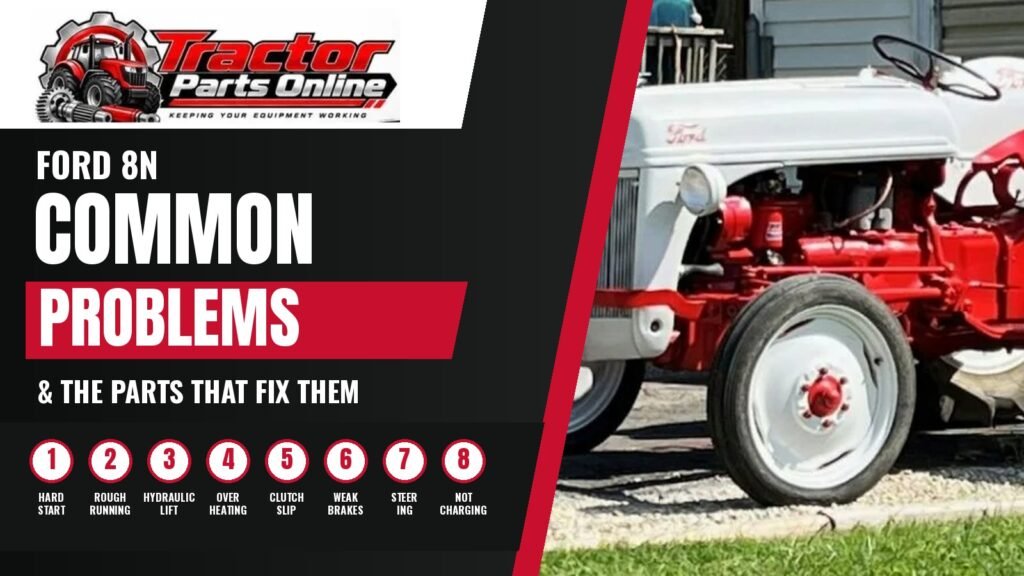
The Ford 8N, built from 1947 to 1952, is one of the most popular tractors ever made in America, and hundreds of thousands are still running today. It’s simple to work on, but after 70+ years almost every 8N shows the same set of problems. Most of them come down to ignition, fuel, hydraulic and seal parts that are still easy to find, and most Ford 8N parts can be matched to your tractor if you know what to ask for.
Below are the eight Ford 8N problems owners ask about most, what usually causes them and which parts fix them.
Ford 8N problems at a glance
| Problem | Most common cause | Check first |
|---|---|---|
| Won’t start or hard starting | Points, condenser, coil, weak 6-volt system | Spark at the plug, points gap, battery cables |
| Runs rough or stalls | Dirty fuel, sediment bowl, carburetor | Sediment bowl and fuel flow |
| Hydraulics won’t lift | Low or wrong oil, pump valves, control linkage | Oil level, then lift linkage adjustment |
| Overheating | Clogged radiator, slack fan belt, water pump | Radiator and fan belt |
| Clutch slipping or dragging | Worn disc, oil on clutch, adjustment | Pedal free play and rear main seal |
| Weak brakes | Worn shoes, leaking axle seals | Oil on brake drums |
| Loose steering | Worn steering sectors and bushings | Play at the steering wheel |
| Not charging | Generator, regulator, wiring | Belt and connections |
Before you order Ford 8N parts: 6-volt or 12-volt, and the serial number
The 8N left the factory with a 6-volt electrical system, but many have since been converted to 12 volts. Ford also made running changes during production, including the distributor design, so early and late 8Ns can take different ignition parts. Before you order, check whether your tractor is 6-volt or 12-volt, note which distributor it has, and find the serial number stamped on the left side of the engine block.
1. Ford 8N won’t start or is hard to start
Likely causes: burned or badly gapped points, a failed condenser, a weak coil, worn spark plug wires, or a 6-volt system with thin or corroded cables that can’t deliver enough current to crank.
Parts that fix it: points and condenser, coil, distributor cap and rotor, spark plugs and wires, heavy-gauge battery cables, starter or starter switch.
2. Runs rough, stalls or loses power
Likely causes: rust and debris from the fuel tank clogging the sediment bowl screen, a dirty or worn carburetor, or a vacuum leak at the manifold.
Parts that fix it: sediment bowl and screen, fuel shut-off valve, carburetor rebuild kit or carburetor, manifold gasket, fuel lines.
3. Ford 8N hydraulics won’t lift
Likely causes: low or contaminated oil (the hydraulics share oil with the rear end), worn or stuck pump valves, a leaking lift cylinder, or the lift control linkage out of adjustment. On the 8N the hydraulic pump runs off the PTO drive, so the PTO must be engaged for the lift to work.
Parts that fix it: hydraulic pump rebuild kit or pump, valve parts, lift cylinder seals, gaskets and O-rings. The same diagnosis steps apply to later Fords; see our guide to Ford 3000 hydraulics not lifting.
4. Overheating
Likely causes: a radiator clogged inside with scale or outside with dirt, a slipping fan belt, a leaking water pump or a weak radiator cap.
Parts that fix it: radiator, radiator cap, water pump, fan belt, hoses.
5. Clutch slipping or dragging
Likely causes: a worn clutch disc, oil on the disc from a leaking rear main seal, a weak pressure plate, or pedal free play out of adjustment. A clutch that drags makes it hard to shift into gear.
Parts that fix it: clutch disc, pressure plate, throw-out bearing, pilot bearing and rear main seal. Replace them together while the tractor is split.
6. Weak brakes
Likely causes: worn brake shoes, or rear axle seals leaking oil onto the shoes so they can’t grip.
Parts that fix it: brake shoes, springs, axle seals and drums. Fix the leaking axle seals first or new shoes will soon be soaked too.
7. Loose or sloppy steering
Likely causes: worn steering sectors and bushings in the steering box, worn tie rod ends, or worn spindle bushings.
Parts that fix it: steering sector and bushing kits, tie rod ends, spindle bushings, steering box seals.
8. Battery not charging
Likely causes: a worn generator, a failed voltage regulator, a loose belt or poor connections. Many owners convert to a 12-volt alternator for easier starting.
Parts that fix it: generator or 12-volt alternator conversion kit, voltage regulator, fan belt, wiring harness.
Ford 8N 6-volt vs 12-volt conversion
| Original 6-volt | 12-volt conversion | |
|---|---|---|
| Originality | Correct for restoration and shows | Not original |
| Starting | Needs heavy cables and good connections | Usually cranks faster and starts easier |
| Parts needed | Generator, regulator, 6V coil and bulbs | Alternator kit, 12V coil (or resistor), 12V bulbs |
| Best for | Collectors and restorations | Working tractors used regularly |
Ford 8N maintenance parts checklist
| Part | Why it matters |
|---|---|
| Points, condenser, plugs | Reliable starting |
| Sediment bowl screen and gasket | Clean fuel to the carburetor |
| Oil filter | Protects the engine |
| Air cleaner oil | The 8N uses an oil-bath air cleaner; keep it clean and filled |
| Fan belt | Prevents overheating and charging problems |
| Grease | Prevents worn spindles and steering parts |
Where to buy Ford 8N parts
As an authorized reseller of Tractor Parts ASAP, we can source new, used and rebuilt antique tractor parts for the Ford 8N and other N-series Fords, from ignition and fuel parts to hydraulic pump kits, clutches and steering parts. Later Fords share many parts with New Holland; see our Ford 3000 tractor parts and New Holland tractor parts. Read us your serial number and a parts specialist will confirm the right part before it ships.
Need a Ford 8N part?
Talk to a parts specialist and get price and availability on the call. In-stock parts ship the same day when you order before 2pm EST.
Frequently asked questions
Why won’t my Ford 8N start?
Check for spark first: points, condenser and coil are the usual culprits. On a 6-volt tractor, thin or corroded battery cables are also a very common cause of slow cranking.
Why won’t my Ford 8N hydraulics lift?
Make sure the PTO is engaged, since the pump runs off the PTO drive. Then check the oil level and the lift control linkage. If it still won’t lift, the pump valves or lift cylinder seals are likely worn.
Should I convert my Ford 8N to 12 volts?
For a working tractor, a 12-volt conversion usually makes starting easier. For a correct restoration, keep the original 6-volt system with good heavy cables.
Do Ford 9N and 2N parts fit the 8N?
Many N-series parts are shared, but not all; the 8N has a different transmission and some different engine and ignition parts. Always confirm fit with your serial number.
Final thoughts
- Most Ford 8N problems trace back to ignition, fuel, worn seals and hydraulic pump wear.
- Check the cheap things first: spark, fuel flow, oil level and adjustment.
- Know whether your 8N is 6-volt or 12-volt before ordering electrical parts.
- Order with your serial number so the part fits the first time.
Pingback: Ford 3000 Hydraulics Not Lifting? 7 Causes & Fixes (2026 Guide)