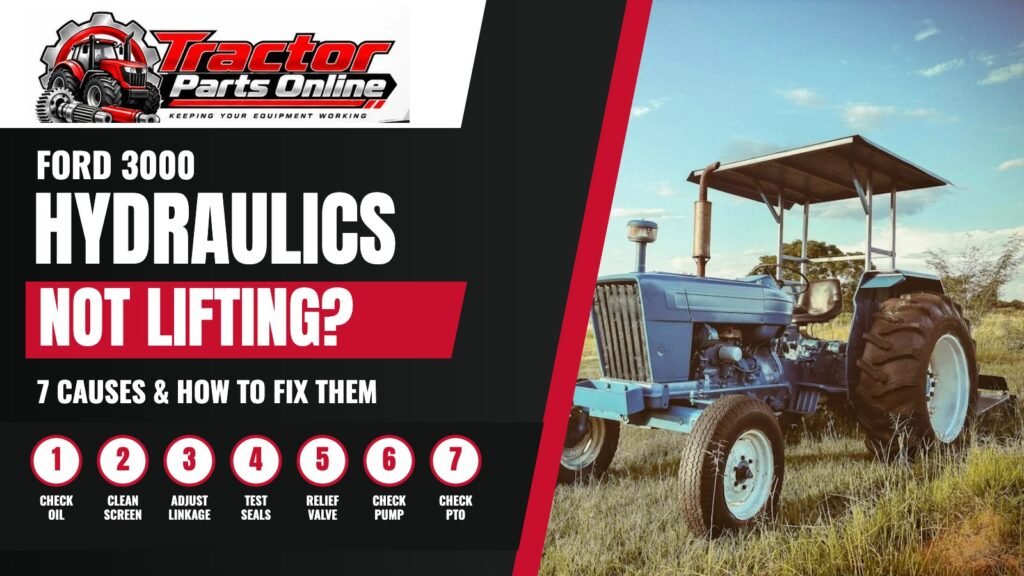
Your Ford 3000 starts fine, but the three-point hitch won’t lift, lifts painfully slowly, or drops the moment you put a load on it. It’s one of the most common problems on these tractors, and the good news is that most causes can be checked in an afternoon with basic tools. In some cases the fix costs nothing. In others, the Ford 3000 hydraulic pump is worn out and needs replacing.
Below are the seven causes we see most often, in the order you should check them: cheapest and easiest first.
How the Ford 3000 hydraulic system works (in 30 seconds)
The Ford 3000 was built from 1965 to 1975. Its hydraulic pump sits inside the rear center housing, under the lift cover, and draws oil from the same sump as the transmission and rear axle. The pump feeds the lift cylinder, which raises the lift arms. Control valves and a relief valve inside the lift cover decide how far the arms go and when pressure is released. Because everything shares one oil supply and most of the parts are hidden under the lift cover, a problem in one place can look like a problem somewhere else. That’s why checking in order matters.
1. Low or wrong hydraulic oil
Symptoms: slow or jerky lift, whining from the rear housing, lift that gets worse as the tractor warms up.
Check: park on level ground with the lift arms fully down, then check the level at the dipstick or fill plug on the rear housing. Look at the oil too. Milky oil means water has got in, which is common on tractors stored outside, and it will damage the pump over time. Use a universal tractor hydraulic fluid that meets the Ford specification listed in your operator’s manual. Engine oil and automatic transmission fluid are not substitutes.
2. Clogged suction screen or filter
Symptoms: the hitch lifts when the tractor is cold, then weakens or stops as it warms up; the pump whines or chatters.
Check: the pump pulls oil through a suction screen and filter. On older tractors these are often decades overdue and packed with sludge, which starves the pump. Draining the oil, cleaning the screen and fitting a new filter is one of the cheapest fixes and one of the most common.
3. Linkage or control lever out of adjustment
Symptoms: the arms lift only part way, won’t respond to the lever, or the draft and position control behave oddly.
Check: the lever connects to the control valve inside the lift cover through linkage that can wear, bend or slip out of adjustment. Check that the lever is in position control (not draft) while testing, and look for loose or bent rods. Adjustment specs are in the Ford service manual. This costs nothing to check and saves many people from buying a pump they didn’t need.
4. Leaking lift cylinder piston seal
Symptoms: the hitch lifts but slowly drops back down with a load on it (“leak down”), even with the engine off.
Check: raise a heavy implement and time how fast it drops. If it creeps down, oil is getting past the lift cylinder piston seal or a valve inside the lift cover. Replacing the piston seal means removing the lift cover, but the parts themselves are inexpensive.
5. Stuck or weak relief valve
Symptoms: the hitch lifts empty but won’t lift a load, or you hear the system “squeal” as it bypasses.
Check: the relief valve protects the system by opening at a set pressure. If it is stuck open or its spring is weak, it dumps oil back to the sump before the hitch can lift anything heavy. A pressure gauge on the test port will tell you whether the system reaches the pressure listed in the service manual.
6. Worn Ford 3000 hydraulic pump
Symptoms: weak lift across the board, worse when hot, even with clean oil at the right level, a clean screen and correct linkage. Low pressure on a gauge test.
Check: after 50+ years, many original pumps have worn pistons, bores and valves. If you’ve ruled out causes 1 to 5 and pressure is still low, the pump is the likely problem. You have two options: rebuild it with a pump rebuild kit, or replace it with a complete Ford 3000 hydraulic pump. A rebuild costs less if the housing and bores are in good shape. A complete pump is faster and usually the better choice when the bores are scored.
7. PTO or drive problem (the one people miss)
Symptoms: no lift at all, and the PTO doesn’t work either.
Check: on the Ford 3000 the hydraulic pump is driven through the PTO drive line. If the PTO doesn’t turn, the pump may not be turning either, so the fault isn’t in the hydraulics at all. Check the PTO drive and the Ford 3000 PTO shaft before pulling the lift cover.
Quick diagnosis table
| What you see | Most likely cause | Check first |
|---|---|---|
| Slow lift, whining | Low oil or clogged screen | Oil level, suction screen |
| Lifts cold, fails when hot | Clogged screen or worn pump | Screen and filter, then pressure test |
| Lifts part way only | Linkage adjustment | Lever and control linkage |
| Drops under load | Piston seal or valve leak | Leak-down test |
| Lifts empty, not loaded | Relief valve | Pressure gauge test |
| No lift and no PTO | PTO drive | PTO shaft and drive |
Before you buy a Ford 3000 hydraulic pump
Ford built several versions of the 3000, and parts changed over the production run. Before ordering, have your tractor’s serial number ready. On most Ford 3000 tractors it’s stamped on the left side of the engine block, above the starter. Matching on the serial number is the surest way to get a pump that fits the first time.
Need a Ford 3000 hydraulic pump or rebuild kit?
Read us your serial number and a parts specialist will match the right pump, kit or seals, with price and availability on the call. In-stock parts ship the same day when you order before 2pm EST.
Frequently asked questions
Why does my Ford 3000 hydraulic lift work when cold but not when hot?
Oil thins as it warms up. A partly clogged suction screen or a worn pump can keep up with thick cold oil but not thin hot oil. Clean the screen and replace the filter first; if the problem stays, test the pump pressure.
Where is the hydraulic pump on a Ford 3000?
Inside the rear center housing, below the lift cover. You reach it by draining the oil and removing the lift cover or the PTO/pump access, depending on your model. Check the service manual for your serial number range.
Should I rebuild or replace my Ford 3000 hydraulic pump?
Rebuild if the pump body and bores are smooth and only the seals, valves or pistons are worn. Replace if the bores are scored or the pump has run dry, because a rebuild kit won’t fix a damaged housing.
Do Ford 2000 and Ford 4000 hydraulic pumps fit the Ford 3000?
Some parts are shared across Ford tractors from the same era, but not all, and fit can change with the serial number. Call us with your serial number and we’ll confirm before you buy.